Cedarcrypt, an applied cryptography summer school and conference, concluded on July 16 after four days at the American University of Beirut’s campus in Paphos, Cyprus, about two hundred kilometers of sea from Lebanon. All year, colleagues and friends have asked me some version of the same question, and I have asked it of myself: why spend a year of eighty-hour weeks building a cryptography course, then a scholarship program, then a conference, for a region the field has never counted? This is the mission of my lifetime.
Communication in the presence of adversaries
Ron Rivest defined cryptography as communication in the presence of adversaries. It remains the best definition available, and it is a strange one: a science whose object is defined by hostility, by the standing assumption that someone is working against you. Number theory assumes no enemy. Cryptography assumes little else.
I was born in Beirut. In the country I come from, Rivest’s phrase is not a technical definition; it is a description of conditions. Since 2019, Lebanon’s currency has lost roughly ninety-eight percent of its value, and depositors have watched their savings sealed inside a banking system that had quietly become insolvent. The state provides a few hours of electricity a day; diesel generators cover the rest. In 2020, a warehouse of ammonium nitrate leveled the port of Beirut in one of the largest non-nuclear explosions ever recorded. In 2024, a war killed thousands and displaced more than a million people in a country of five million. The World Bank ranks the compound collapse among the most severe crises anywhere since the middle of the nineteenth century. Ordinary life in Lebanon has become an exercise in operating in the presence of adversaries: institutional, economic, military, and increasingly digital.
So when I began teaching applied cryptography to fifty-five students at the American University of Beirut in the fall of 2025, certain things did not need to be taught. I have watched seasoned engineers in peaceful countries struggle to take metadata seriously as a threat. My students had relatives who were tracked through their phones during the war. Nobody asked why forward secrecy matters, or why a protocol should assume the server is hostile, or why anyone would bother hiding who talks to whom. Their threat model predated my whiteboard: it was the family group chat.
The geography of cryptographic expertise is upside down. The field concentrates its people, funding, conferences, and prestige in a handful of prosperous capitals, places where cryptography is a profession. It is thinnest where cryptography is a lifeline: post-conflict states, blackout zones, societies under active surveillance. I claim no position outside this pattern; I built my career and my firm in Paris and have spent years enjoying the field’s comforts. But a discipline that theorizes adversarial conditions while absenting itself from nearly every place that suffers them has an incomplete claim to its own name. Bringing the expertise to where the adversaries actually operate is what the phrase real-world cryptography ought, at minimum, to mean.
Fifty-five students
The course was built from scratch: about 1,500 slides, eight problem sets, eight implementation projects in Go and Rust, a syllabus that starts at the one-time pad and ends at zero-knowledge proofs and post-quantum systems. Most of the fifty-five had never seen a security definition. The conditions were what they were. Israeli drones passed low over campus most days, often during lecture. Power cuts were routine, and students debugged their Double Ratchet implementations on laptop batteries. I expected all of this to degrade the course, and it did the opposite. Simone Weil called attention the rarest and purest form of generosity; whatever that is as metaphysics, as a description of a classroom in a collapsing country it is exact. Attention there is expensive, and people who choose to spend it on you have made an actual decision.
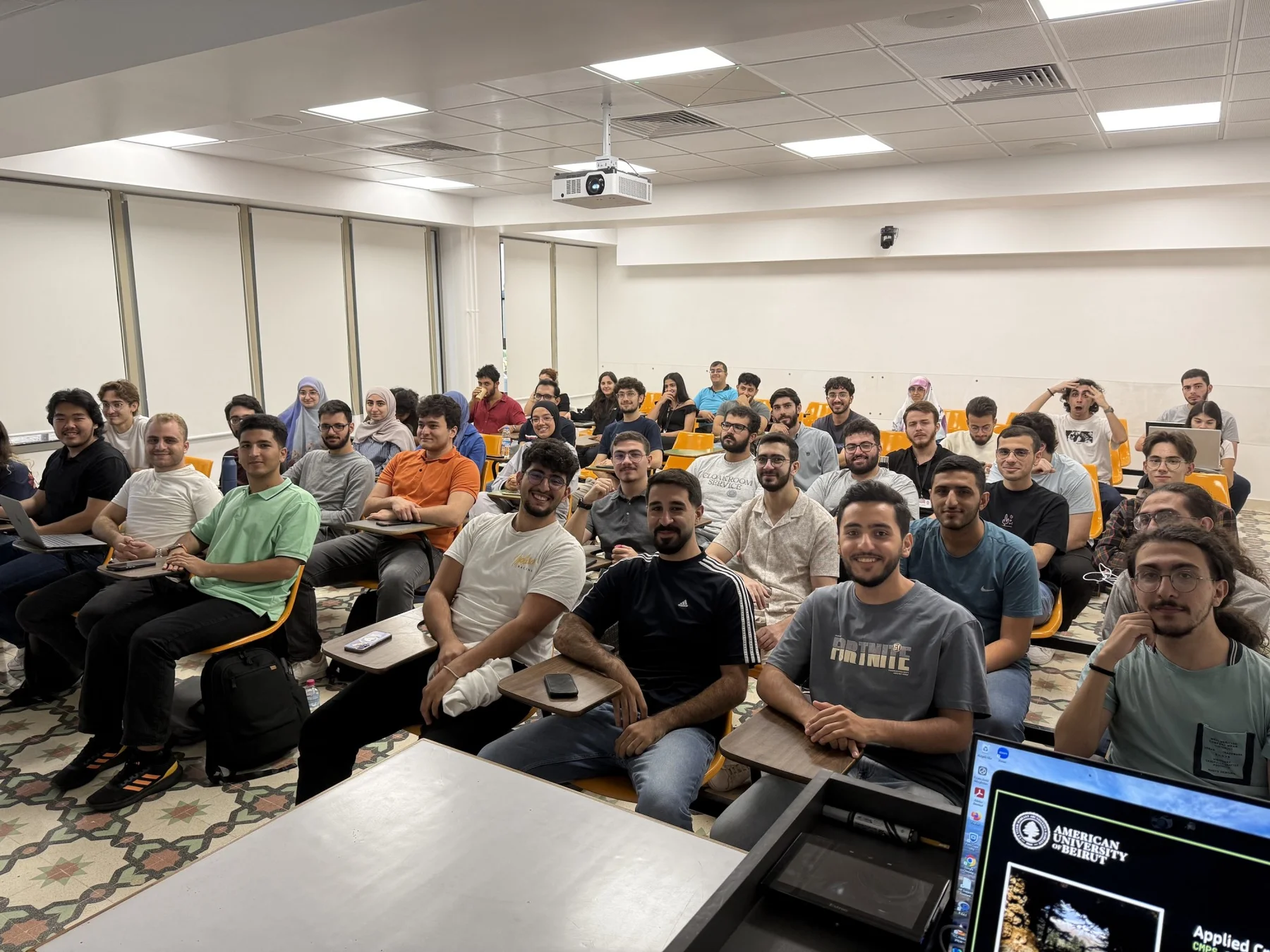
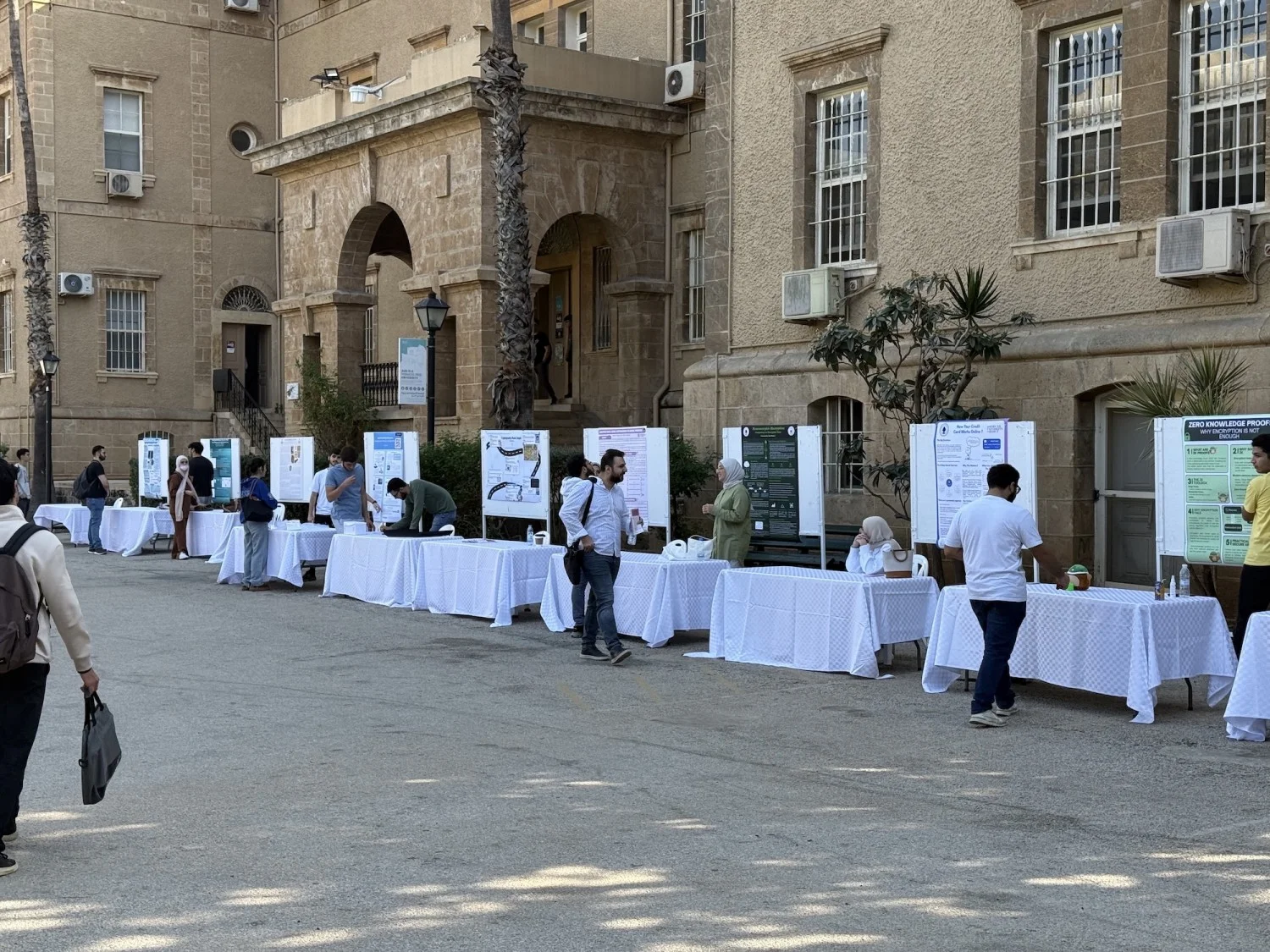
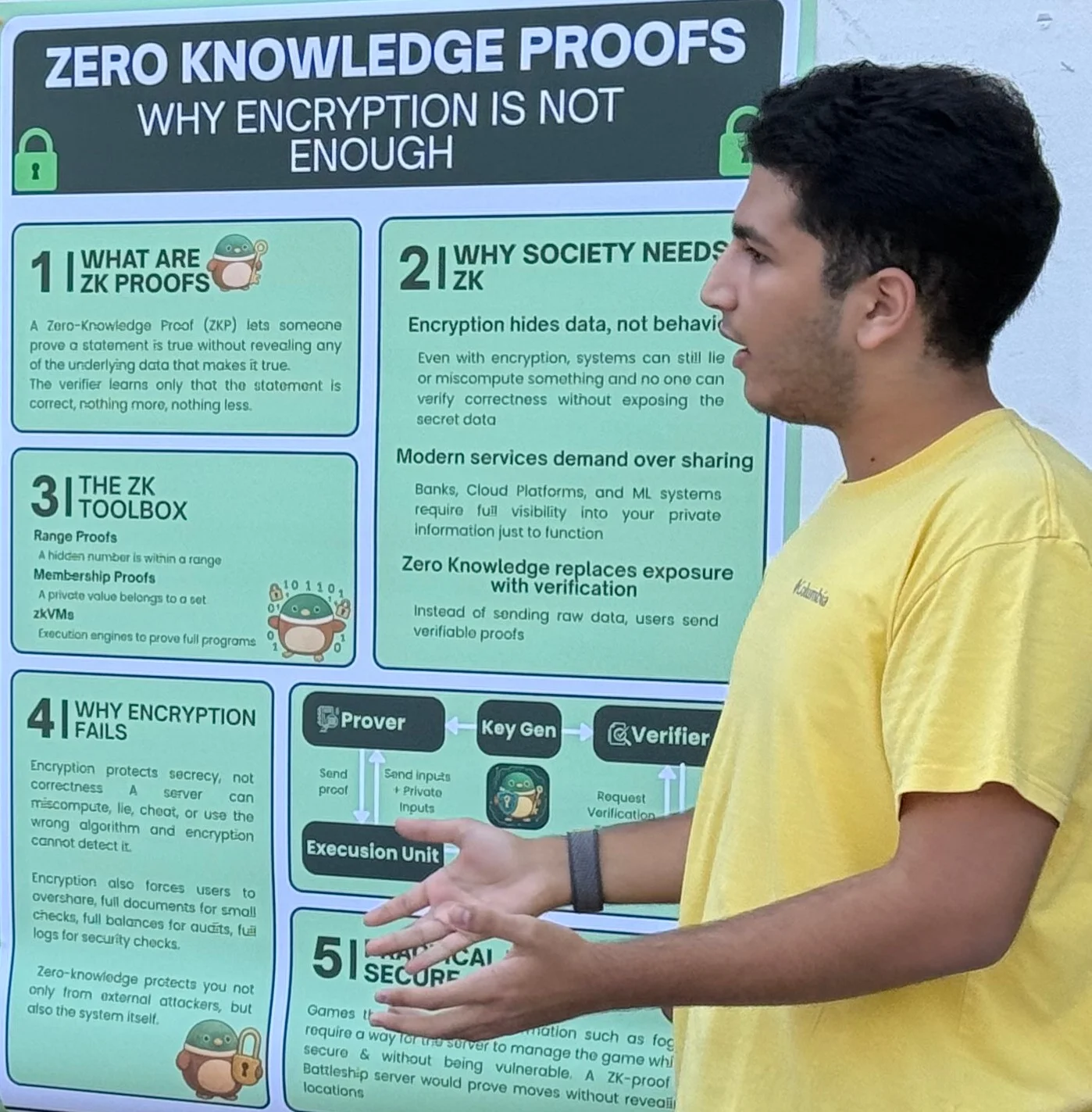
Teaching there showed me something that I suspect is invisible from inside the field’s usual venues: most of the difficulty of cryptography is not difficulty. It is intimidation. The notation is more frightening than the ideas it encodes. When I presented Diffie–Hellman in full formal dress, safe primes and cyclic subgroups and a decisional assumption quantified over probabilistic polynomial-time adversaries, I watched faces close. When I presented the same idea as clock arithmetic, the same students started asking exactly the right questions, and weeks later were reading the formal treatment on their own, because by then they knew the notation was shorthand for something they already understood. The obstacle was never the mathematics but an acquired belief, installed by years of small signals, that this field belongs to other people. We treated that belief as a technical problem and worked on it deliberately: optional student presentations that filled the room anyway, a poster session, a weekly coffee-shop-style, donut-laden gathering called The Key Exchange where the conversation ran from lattice reductions to how one writes to a professor one has never met. The field helped more than I had any right to expect. Jean-Philippe Aumasson flew to Beirut to lecture in person; Kenny Paterson, Rolfe Schmidt, Nigel Smart, Vitalik Buterin and others gave their time in a semester when engaging with Lebanon was not a light decision.
Students who found the first problem set bewildering earned near-perfect scores on the fourth. The final exam, which I published openly so that colleagues could judge its difficulty for themselves, averaged 82 out of 100. By semester’s end, students who had begun with nothing had implemented Signal’s Double Ratchet, built hybrid post-quantum systems on ML-KEM and ML-DSA, written zero-knowledge applications, and formally verified protocols. One of them, Silina Elfil, produced state-separable proofs cleaner and shorter than the published ones in the textbook she was learning from. Strong departments in Europe and North America now write to ask me for these students. A door was opened, and the people on the other side of it turned out to be as capable as anyone should have assumed all along.
That semester took five months of eighty-hour weeks, and I corrected more than 2,300 pages of assignments and exams by hand, alone. In the accounting my field uses to allocate careers, all of it counts for less than a single workshop paper. I knew this going in; colleagues confirmed it, kindly, as a warning. We have built an economy of recognition in which the work that most changes lives is the work that does not count, and professors at every university you know spend entire careers on the wrong side of that ledger. I said a version of this from the stage at Real World Crypto earlier this year: we hand one another recognitions we will not care about at the end of our lives while withholding them from the work we will. Two of my students were supposed to be at that conference with me. Their flights out of Beirut were canceled at the last minute because of the war, and I opened the talk beneath their photographs. The field’s incentive structures, unlike the war, are ours: we built them, and we can build different ones.
Precedents
Cedarcrypt’s logo is a broken Phoenician tablet mended back together with gold, in the manner of Japanese kintsugi, the craft of repairing fractured pottery with lacquer dusted or mixed with gold so that the seams are not hidden but illuminated. I chose it because the break is not disguised. The mend is worth more than the unbroken original precisely because it makes the fracture part of the object’s history. The Phoenician tablet stands for the region that gave the alphabet to the world; the gold seams stand for what can be made of a thing after it has been shattered.
The university stands for the same thing. AUB was founded in 1866 and has held classes through famine, world wars, fifteen years of civil war, and the current collapse. In 1948, Constantine Zurayk, a historian there, wrote a short, severe book called The Meaning of the Disaster, arguing that the answer to regional catastrophe was neither slogan nor lament but the patient, generational mastery of modern science. I make no grand claims for one cryptography course, but I know whose program I am following. And when Bana Bashour opened Cedarcrypt with a talk on higher education that turned on Plato’s cave, her point being that the ascent toward the light is only half of Plato’s argument and that the one who ascends is obligated to go back down, she was making a general case about universities. For me it doubled as a precise account of why I went back to Beirut to teach.
Four days in Paphos
Cedarcrypt was hosted in Paphos instead of Beirut because I could not yet responsibly ask the international community to convene inside Lebanon, and I could not hang two dozen student scholarships on travel logistics that one bad week could unmake. Cyprus is the standing answer to this problem. During the civil war, when Beirut’s port and airport closed, the ferry from Jounieh to Larnaca became Lebanon’s route to the world, and a good part of Lebanese commercial life ran from the island until home reopened. AUB now keeps a campus in Paphos, AUB Mediterraneo, our host and co-organizer, and its teaching therefore no longer depends entirely on conditions at home. Convening there was a compromise. I want a future edition of Cedarcrypt to meet in Beirut, the moment it can be done responsibly.
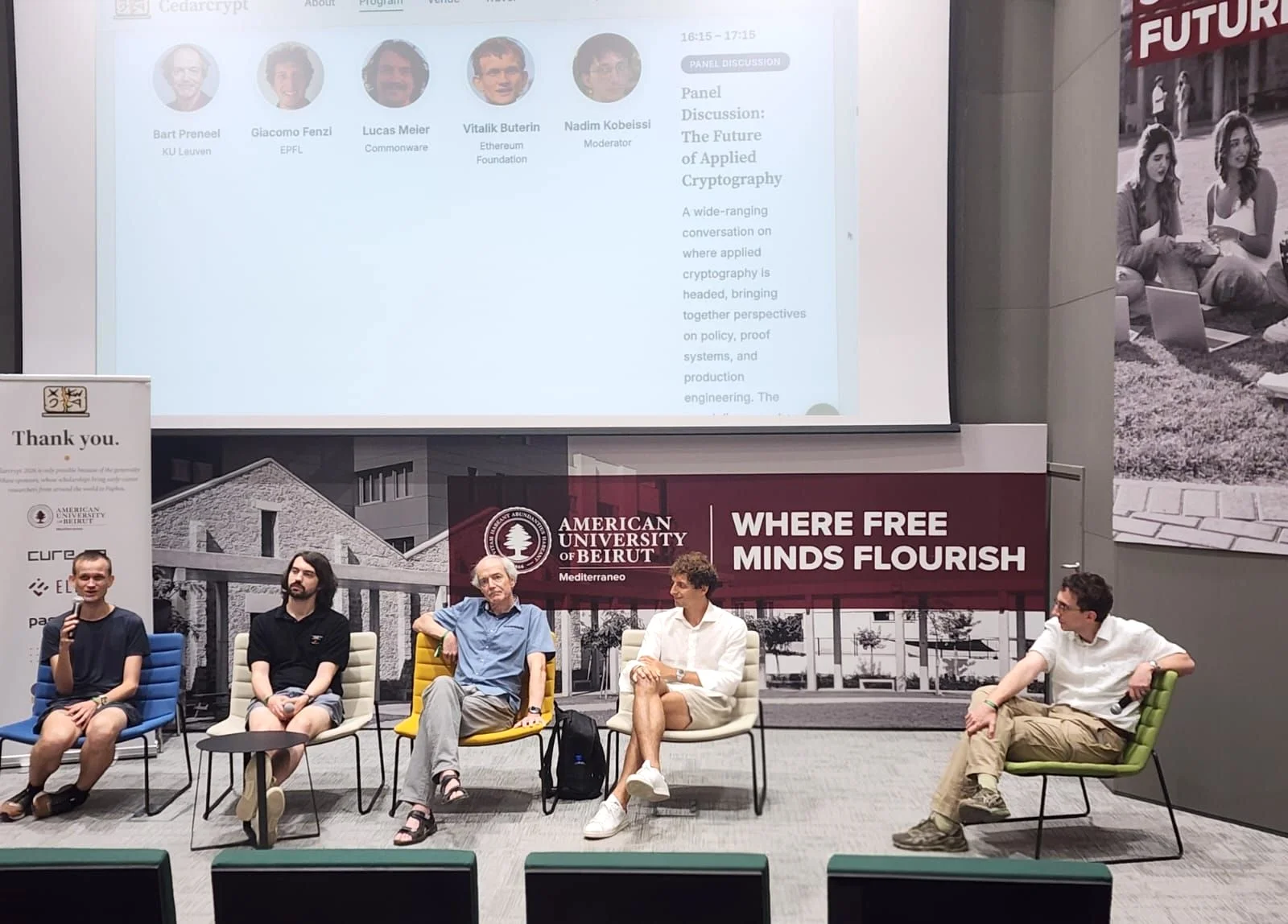
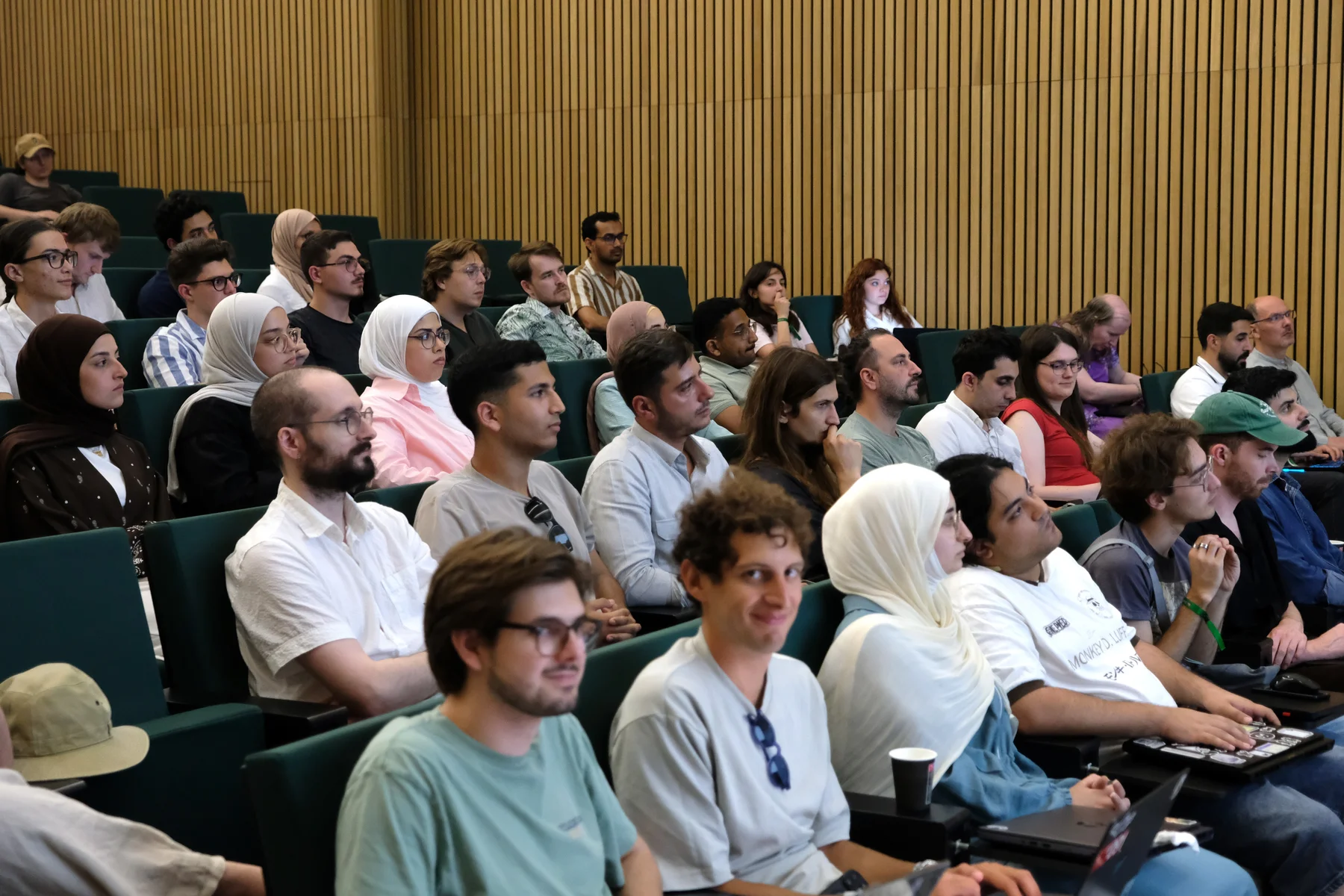
The program itself: Bart Preneel, who heads the COSIC group at KU Leuven, traced fifty years of the Crypto Wars, from the Clipper Chip to client-side scanning, before an audience for whom the question of who may read one’s messages has never been academic. Meryem Cherkaoui Semmouni, of Sidi Mohamed Ben Abdellah University in Morocco, spent the first afternoon leading students through lattice attacks on RSA with the LLL algorithm. Engineers and researchers from Mozilla, The Guardian, Nokia Bell Labs, and the threshold-cryptography world taught constant-time programming, web transparency logs, homomorphic encryption in production, and group messaging for whistleblowing systems. Students implemented components of hash-based SNARKs in a three-hour workshop. A panel put a former IACR president and the co-founder of Ethereum in front of students who twelve months earlier had no path into the field. There were lightning talks; the best won a hardcover of Mike Rosulek’s excellent The Joy of Cryptography. There was a dinner on a mountaintop above Paphos, and a day trip along the coast before the program began, to the sanctuary of Aphrodite at Palaepaphos and the theatre at Kourion, because communities form on buses and over long lunches at least as reliably as in lecture halls.
On the morning of July 11, most of our scholarship students boarded the same Middle East Airlines flight out of Beirut, and a chartered bus met them at Larnaca airport to take them to the student dorms. More than two dozen attendees came on scholarship support, the majority from Lebanon, joined by two more who flew in from Cairo and Zurich. The funding came from Cure53, Zama, PQShield, Electi, and Passbolt, and from anonymous donors, one of whom, a private individual, gave more than any company; the event ran in collaboration with the IACR. Among the students on that flight were some of those whose flights to Real World Crypto the war had canceled in the spring. This time the plane took off.
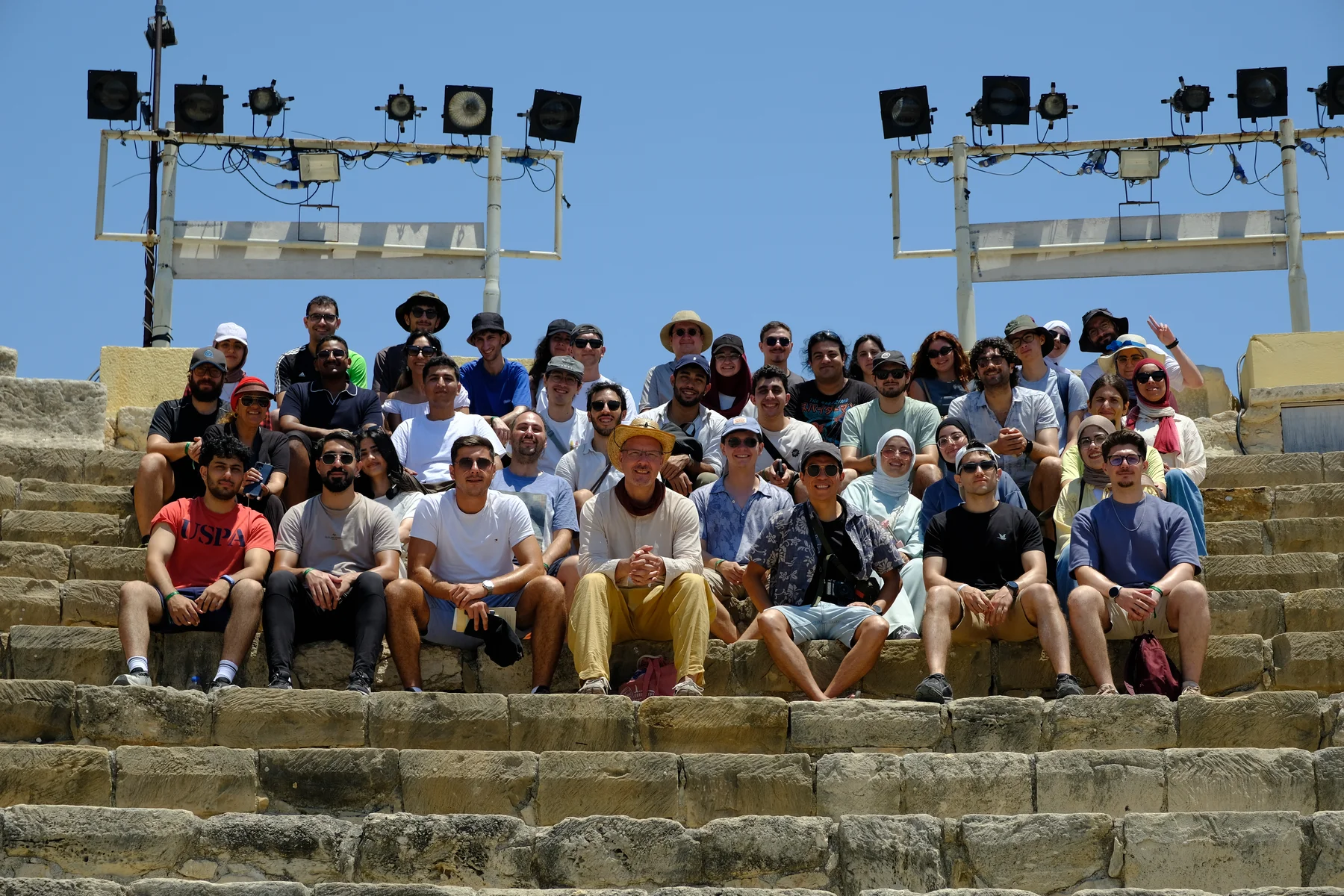
The full Cedarcrypt 2026 photo album is available on Flickr.
This conference was organized in substantial part by my former students. The workshop chair, the web secretary, the sponsorship secretary, the logistics secretary, the ethics officer: a year ago, every one of them was sitting in a lecture hall in Beirut learning what a pseudorandom function is. This summer they negotiated with sponsors, ran international logistics, and staffed the registration desk of an institution that had not existed a year earlier. The distance from student to builder of institutions was twelve months.
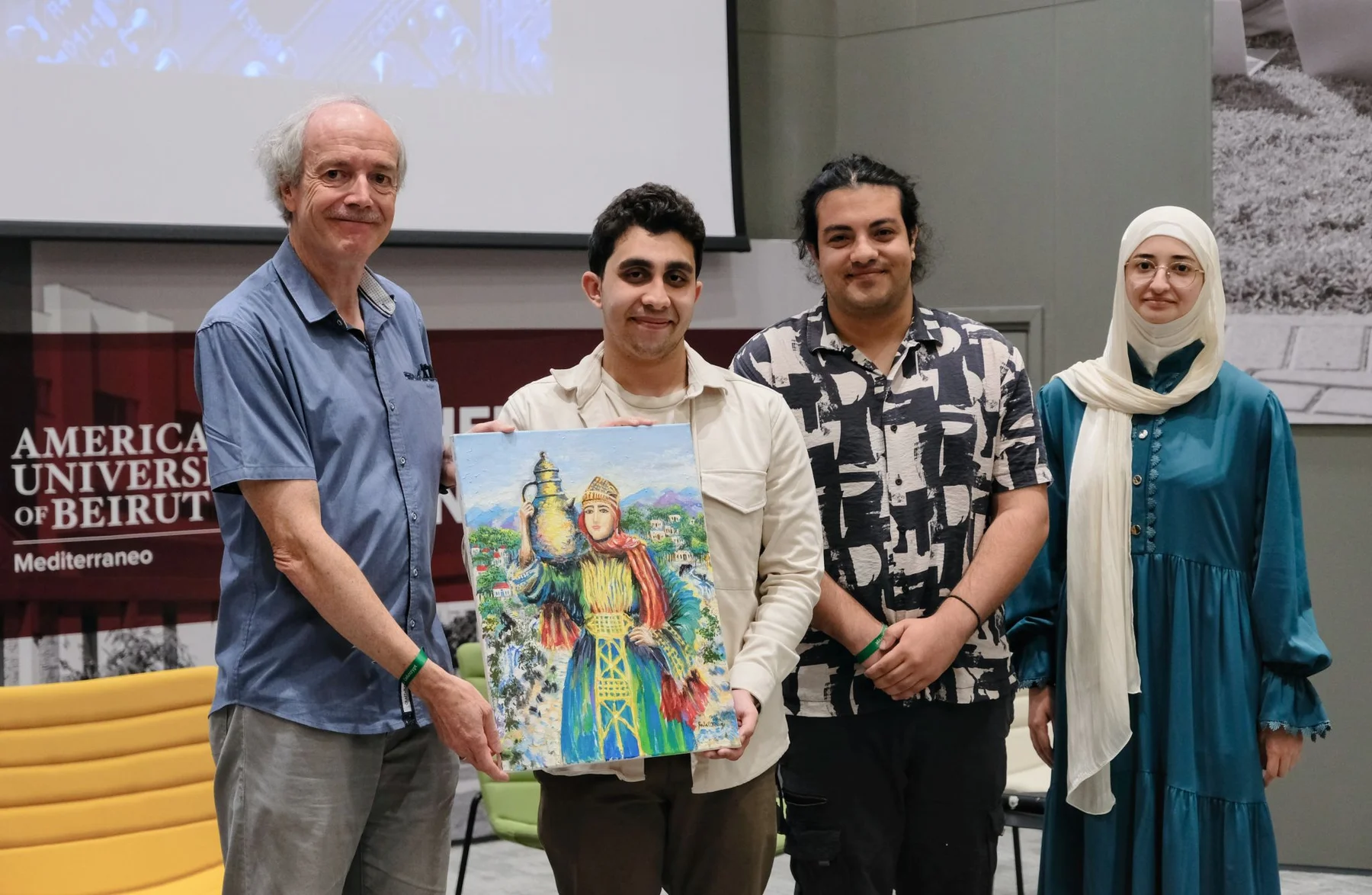
On the first day, three of these organizers walked on stage and gave Bart Preneel a painting: a woman in the embroidered dress of the old Levant, carrying a water jar up through a hillside village.
The attendees are writing their own accounts now. One, a master’s student at AUB, wrote that this was their first conference and that a highlight was discussing their own research with Vitalik Buterin. Another, a graduate student at Beirut Arab University who came on scholarship, wrote of leaving with more questions and more motivation than they had arrived with, and that this felt like the whole point. I could not have put the success criterion better, and I did not have to. A student wrote it!
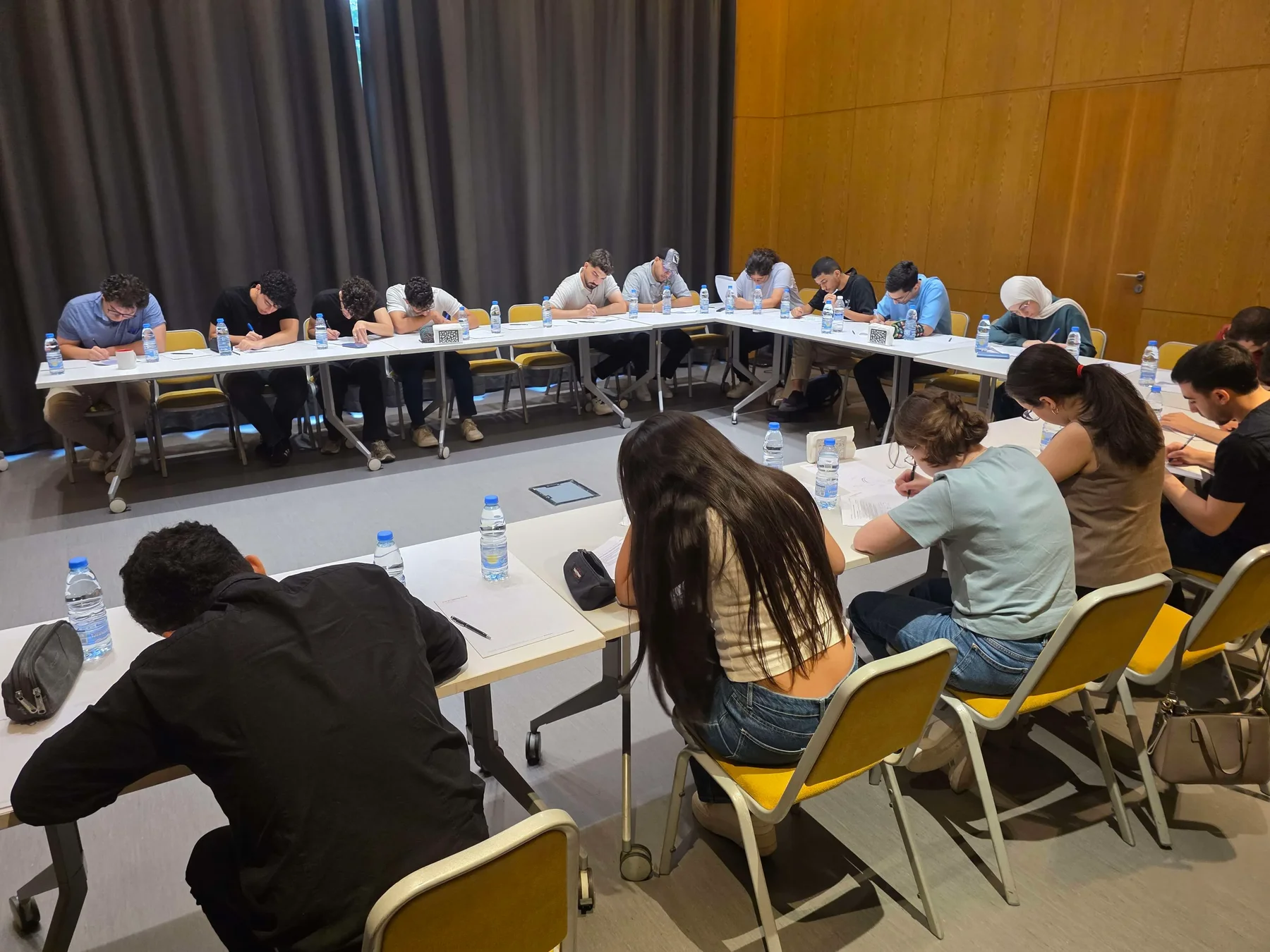
Meanwhile the teaching continues. This summer’s free online cohort, which initially accepted fifty students from nine institutions with the Lebanese University foremost among them, is mid-semester right now, meeting Tuesdays and Thursdays at eleven in the morning, Beirut time. The materials are open under Creative Commons, permanently. And the course written for Beirut is now the foundation of applied cryptography teaching at Ruhr University Bochum, Technische Hochschule Lübeck, the University of Vienna, and the University of Edinburgh. The expertise was supposed to flow in the other direction.
The decades ahead
The strongest of my students receive offers from abroad; I write their recommendation letters gladly, and every letter costs me something. A region does not keep its field by barring the door. It keeps its field by building reasons to stay and bridges for those who leave to remain part of the work. The old cities of this coast never held an empire; they held a network, and the network outlasted the empires that sacked them. That is the working model: a community whose members may sit in Waterloo or Zurich or Hamra, with its center of gravity in the Levant all the same.
Cedarcrypt returns in 2027. The summer program will run again, free, for as long as I can fund and staff it. The course materials remain open, and I will help any university anywhere that wants to teach from them, as four already do. I will keep making the argument about incentives in every venue that will have me: a field that cannot count the work of building people has resigned itself to remaining a guild of the fortunate. And the long-term goal, at the ten- and twenty-year mark, is for this mission to become unnecessary. Cryptography in the Levant will have succeeded when it is unremarkable, when a student in Tripoli or Saida can find a course, an advisor, a community, and a career without any of it depending on one exhausted man and his friends.
None of this belongs to me alone. Wassim El Hajj, AUB Mediterraneo’s rector, Malek Tabbal, my co-chair, and the leadership of AUB and AUB Mediterraneo, who said yes when yes was expensive. Jean-Philippe Aumasson and Lucas Meier, who helped me build the program. Ghady Youssef, Abd El Kader Kahil, Rabab Salim, Nai Hamdan, and Faysal Elestwani, the students who became organizers. The AUB faculty who carried the course with me through the fall. The sponsors, and the donors who asked for nothing, not even their names. The speakers who crossed the world for a first-edition conference on the strength of an idea. My wife, Arij, who kept believing in this throughout. And my students, who are the entire point.
The painting the students chose is an image of provision as work: unglamorous, scheduled, indispensable. That is what teaching is, and it is what building a field will be: water carried uphill, on a schedule, for years. Two hundred kilometers east of that stage is the city where this started and where I intend for it to continue. In the meantime there is a cohort mid-semester, a 2027 edition to plan, and water to carry.